ClaMOUr

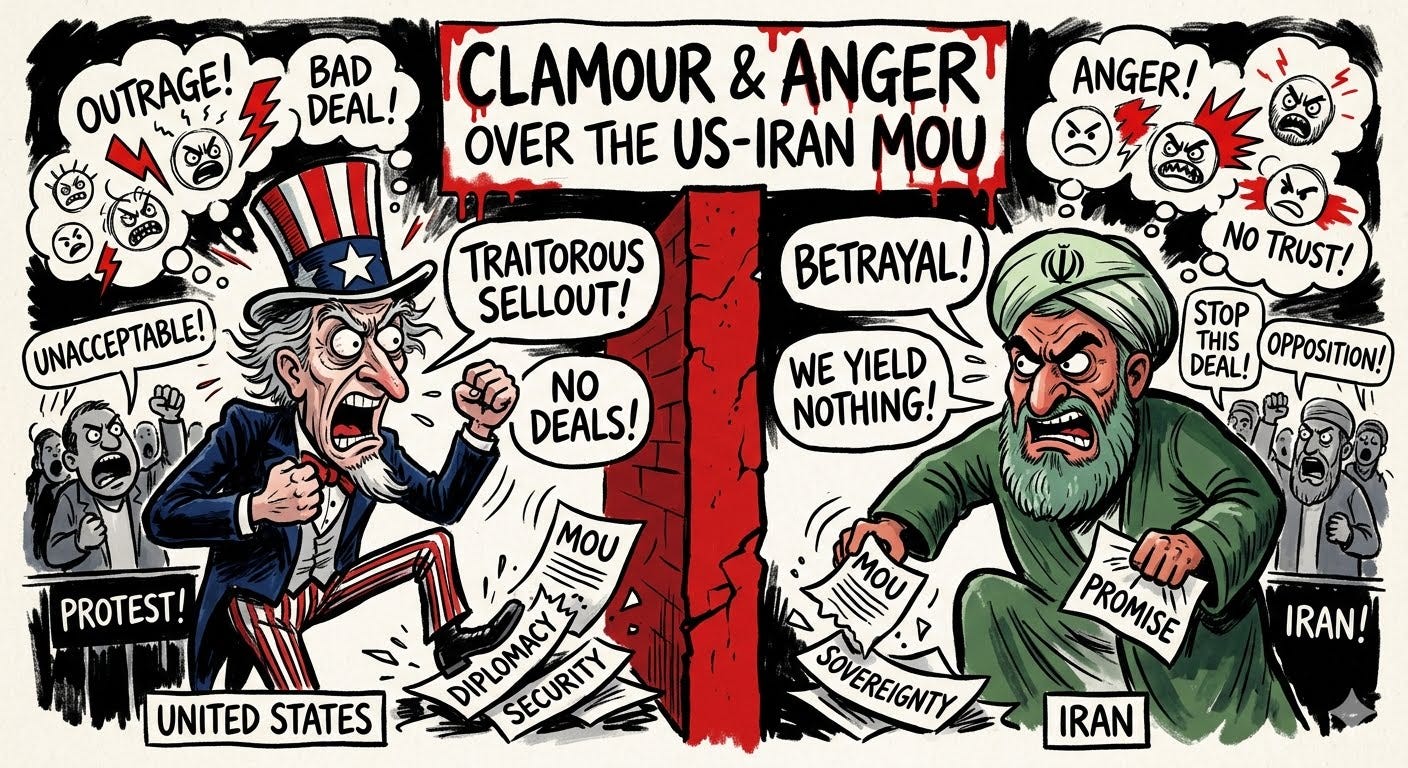
What an eventful week – we got the MOU signed and we got our first look at the new Fed Chair. Both went slightly better than I thought, although I didn’t have high expectations for either. I have opinions on both of these developments.
But first the Week in News:
· I thought Warsh did a good job at his first meeting. It is clear he had to manage a hawkish revolt from about half the members. He doesn’t believe in forward guidance, so he didn’t say much. I liked his committee approach to tackling some of his proposed changes. Having the other members participate will help develop buy-in. Of course, if he starts jamming all of the committees with his Project 2025 buddies, that could backfire on gaining FOMC acceptance.
· I thought an interesting quote that no one talked about was when he said “You’ve heard me say before I tend to focus on the left of the decimal point. Well, the ‘two’ is the left of the decimal point. For now, zero is to the right.” That is mostly hawkish to say that you want to get to a 2.0% target. However, when he says, “for now” it’s not clear WHEN/if that could change. I’m wondering to what extent the formation of committees, the focus on trimmed mean and that weak house legislation on trying to change the Fed to a single inflation mandate are all about trying to create the path for a rate cut. But this is all in the medium term.
· Warsh’s most hawkish comments related to a focus on inflation fighting: “We will deliver on price stability.” Every FOMC member (“unambiguously and unanimously”) needs to think that (especially in light of the stronger employment data) to maintain inflation expectations. But this focus on inflation could a double-edged sword, if inflation collapses. Gas was below $4, and assuming both sides keep to the MOU, it wouldn’t be crazy to think oil and gas couldn’t go lower.
· The market extreme reaction in the front end was an interesting example of why forward guidance (in the dots) may cause MORE volatility. This is especially true if the post-MOU and post-World Cup data becomes more subdued. The market’s more muted reaction in the longer end could be an example of how forward guidance could cause LESS volatility in the longer end of the curve.
· The US and Iran both signed the MOU, and should start discussions over the weekend. I’m assuming this Lebanon skirmish will blow over sooner, rather than later, so for now, I’ll just put that tail risk on the back-burner. I am assuming Iran didn’t just sign the MOU to collect a small piece of the unfrozen funds and to get a few tankers out. I discuss the War further in today’s main essay:
